
Home Practice
For learners and parents For teachers and schools
Past papers Textbooks
Mathematics
Mathematics Grade 7 Mathematics Grade 8 Mathematics Grade 9 Mathematics Grade 10 Mathematics Grade 11 Mathematics Grade 12
Mathematical Literacy
Mathematical Literacy Grade 10
Physical Sciences
Physical Sciences Grade 10 Physical Sciences Grade 11 Physical Sciences Grade 12
Natural Sciences
Natural Sciences Grade 4 Natural Sciences Grade 5 Natural Sciences Grade 6 Natural Sciences Grade 7 Natural Sciences Grade 8 Natural Sciences Grade 9
Life Sciences
Life Sciences Grade 10
CAT
CAT Grade 10 CAT Grade 11 CAT Grade 12
IT
IT Grade 10 IT Grade 11 IT Grade 12
Full catalogue
Leaderboards
Learners Leaderboard Grades Leaderboard Schools Leaderboard
Campaigns
Headstart #MillionMaths
Learner opportunities Pricing Support
Help centre Contact us
Log in

We think you are located in South Africa. Is this correct?

4.2 Tissues

4.2 Tissues (ESG64)

What is a tissue?

Learners are introduced to the concept of a tissue as a group of similar cells adapted for a particular function. Encourage learners to try and list or identify some tissue types. Throughout the chapter, emphasise the relationship between basic structure of the tissue and its function.

Tissues are made up of a group of similar cells that are adapted for a particular function. Organs are then formed by the functional grouping together of multiple tissues.
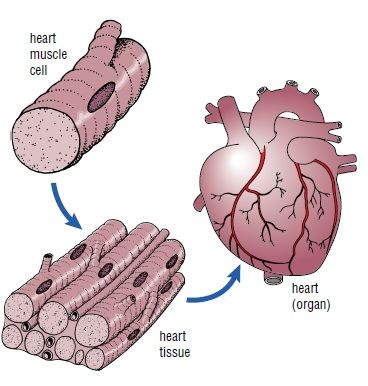
Figure 4.1: The diagram above depicts how several cells adapted for the same function work in conjunction to form tissues, and together form an organ.

In this chapter we will be studying plant and animal tissues, starting with plant tissues.

Simulation: 2CR2