
Home Practice
For learners and parents For teachers and schools
Past papers Textbooks
Mathematics
Mathematics Grade 7 Mathematics Grade 8 Mathematics Grade 9 Mathematics Grade 10 Mathematics Grade 11 Mathematics Grade 12
Mathematical Literacy
Mathematical Literacy Grade 10
Physical Sciences
Physical Sciences Grade 10 Physical Sciences Grade 11 Physical Sciences Grade 12
Natural Sciences
Natural Sciences Grade 4 Natural Sciences Grade 5 Natural Sciences Grade 6 Natural Sciences Grade 7 Natural Sciences Grade 8 Natural Sciences Grade 9
Life Sciences
Life Sciences Grade 10
CAT
CAT Grade 10 CAT Grade 11 CAT Grade 12
IT
IT Grade 10 IT Grade 11 IT Grade 12
Full catalogue
Leaderboards
Learners Leaderboard Grades Leaderboard Schools Leaderboard
Campaigns
Headstart #MillionMaths
Learner opportunities Pricing Support
Help centre Contact us
Log in

We think you are located in South Africa. Is this correct?

Introduction

Test yourself now

High marks in science are the key to your success and future plans. Test yourself and learn more on Siyavula Practice.

Sign up and test yourself

Chapter 7: Algebraic equations (Part 1)

7.1 Introduction

Music writing and algebraic equations have a lot in common. A song is a sequence of notes, arranged together into patterns by the composer. And algebra is the study of patterns.

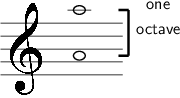
A musical note one octave lower than another has exactly half the frequency of the higher note. Here is an example showing a high note \(A\), and an \(A\) note one octave lower.
In this chapter, you will learn to find numbers that make certain statements true. A statement about an unknown number is called an equation. When we work to find out which number will make the equation true, we say we solve the equation. The number that makes the equation true is called the solution of the equation. Sometimes there are many solutions and sometimes there is only one.