Home Practice
For learners and parents For teachers and schools
Past papers Textbooks
Mathematics
Mathematics Grade 7 Mathematics Grade 8 Mathematics Grade 9 Mathematics Grade 10 Mathematics Grade 11 Mathematics Grade 12
Mathematical Literacy
Mathematical Literacy Grade 10
Physical Sciences
Physical Sciences Grade 10 Physical Sciences Grade 11 Physical Sciences Grade 12
Natural Sciences
Natural Sciences Grade 4 Natural Sciences Grade 5 Natural Sciences Grade 6 Natural Sciences Grade 7 Natural Sciences Grade 8 Natural Sciences Grade 9
Life Sciences
Life Sciences Grade 10
CAT
CAT Grade 10 CAT Grade 11 CAT Grade 12
IT
IT Grade 10 IT Grade 11 IT Grade 12
Full catalogue
Leaderboards
Learners Leaderboard Grades Leaderboard Schools Leaderboard
Campaigns
Headstart #MillionMaths
Learner opportunities Pricing Support
Help centre Contact us
Log in

We think you are located in South Africa. Is this correct?

Properties of 3D objects

25.3 Properties of 3D objects

There are certain words that we need to use when we describe the properties of 3D objects, such as face, base, edge and vertex.

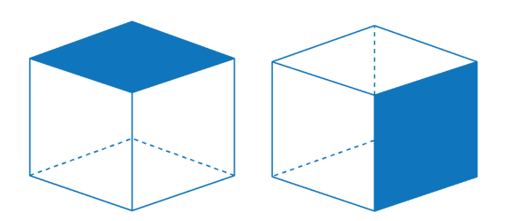
We know that a cube has six faces, and each face is a square. All the squares are congruent (exactly the same size).

face
the flat surface of a 3D object

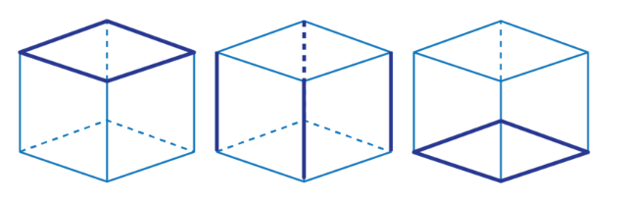
The faces of objects meet each other at an edge. A cube has twelve edges: four edges around the top face of the cube, four edges around the side faces, and four edges around the base of the cube.

edge
the line segment along which two faces of a 3D object join together

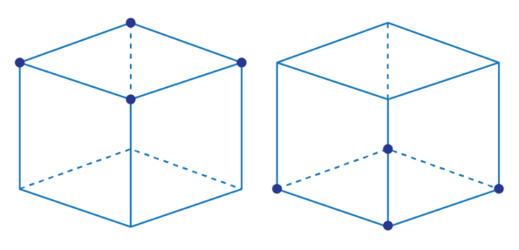
The edges of a 3D object meet each other at a vertex. A cube has eight vertices: four at the top of the cube and four at the base of the cube.

vertex
the corner or point where edges of a 3D object meet

Test yourself now

High marks in science are the key to your success and future plans. Test yourself and learn more on Siyavula Practice.

Sign up and test yourself
Exercise 25.1

This shape is a triangular prism.
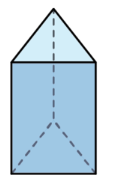
  1. Count the number of faces.
  2. How many edges does it have?
  3. How many vertices does it have?
  1. \(5\) faces
  2. \(9\) edges
  3. \(6\) vertices

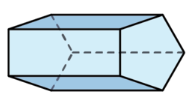
This shape is a pentagonal prism.

  1. Count the number of faces.
  2. How many edges does it have?
  3. How many vertices does it have?
  1. \(7\) faces
  2. \(15\) edges
  3. \(10\) vertices

This shape is called a cuboid or rectangular prism.
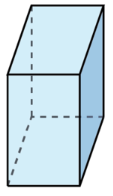
Count the number of faces, edges and vertices.

\(6\) faces, \(12\) edges and \(8\) vertices

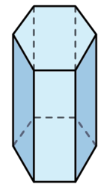
This shape is a hexagonal prism.

Count the number of faces, edges and vertices.

\(8\) faces, \(18\) edges and \(12\) vertices