
23.2 Interactions of the hydrosphere
|
Previous
23.1 Introduction
|
Next
23.3 Exploring the hydrosphere
|
23.2 Interactions of the hydrosphere (ESAHR)
It is important to realise that the hydrosphere is not an isolated system, but rather interacts with other global systems, including the atmosphere, lithosphere and biosphere. These interactions are sometimes known collectively as the water cycle.
The total mass of the hydrosphere is approximately \(\text{1,4} \times \text{10}^{\text{18}}\) tonnes! (The volume of one tonne of water is approximately \(\text{1}\) cubic meter (this is about \(\text{900}\) A4 textbooks!))
-
Atmosphere
When water is heated (e.g. by energy from the sun), it evaporates and forms water vapour. When water vapour cools again, it condenses to form liquid water which eventually returns to the surface by precipitation e.g. rain or snow. This cycle of water moving through the atmosphere and the energy changes that accompany it, is what drives weather patterns on earth.
-
Lithosphere
In the lithosphere (the ocean and continental crust at the Earth's surface), water is an important weathering agent, which means that it helps to break rock down into rock fragments and then soil. These fragments may then be transported by water to another place, where they are deposited. These two processes (weathering and the transporting of fragments) are collectively called erosion. Erosion helps to shape the earth's surface. For example, you can see this in rivers. In the upper streams, rocks are eroded and sediments are transported down the river and deposited on the wide flood plains lower down.
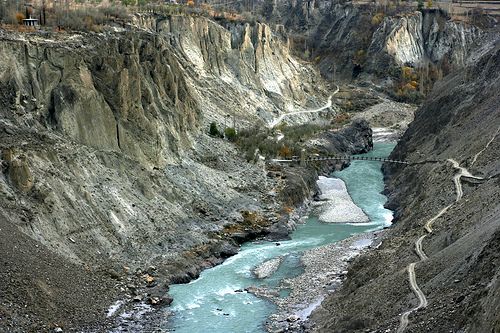
On a bigger scale, river valleys in mountains have been carved out by the action of water, and cliffs and caves on rocky beach coastlines are also the result of weathering and erosion by water. The processes of weathering and erosion also increase the content of dissolved minerals in the water. These dissolved minerals are important for the plants and animals that live in the water.
River valley
-
Biosphere
In the biosphere, land plants absorb water through their roots and then transport this through their vascular (transport) system to stems and leaves. This water is needed in photosynthesis, the food production process in plants. Transpiration (evaporation of water from the leaf surface) then returns water back to the atmosphere.
|
Previous
23.1 Introduction
|
Table of Contents |
Next
23.3 Exploring the hydrosphere
|