
Home Practice
For learners and parents For teachers and schools
Past papers Textbooks
Mathematics
Mathematics Grade 7 Mathematics Grade 8 Mathematics Grade 9 Mathematics Grade 10 Mathematics Grade 11 Mathematics Grade 12
Mathematical Literacy
Mathematical Literacy Grade 10
Physical Sciences
Physical Sciences Grade 10 Physical Sciences Grade 11 Physical Sciences Grade 12
Natural Sciences
Natural Sciences Grade 4 Natural Sciences Grade 5 Natural Sciences Grade 6 Natural Sciences Grade 7 Natural Sciences Grade 8 Natural Sciences Grade 9
Life Sciences
Life Sciences Grade 10
CAT
CAT Grade 10 CAT Grade 11 CAT Grade 12
IT
IT Grade 10 IT Grade 11 IT Grade 12
Full catalogue
Leaderboards
Learners Leaderboard Grades Leaderboard Schools Leaderboard
Campaigns
Headstart #MillionMaths
Learner opportunities Pricing Support
Help centre Contact us
Log in

We think you are located in South Africa. Is this correct?

8.3 Crests and troughs

Test yourself now

High marks in science are the key to your success and future plans. Test yourself and learn more on Siyavula Practice.

Sign up and test yourself

8.3 Crests and troughs (ESACM)

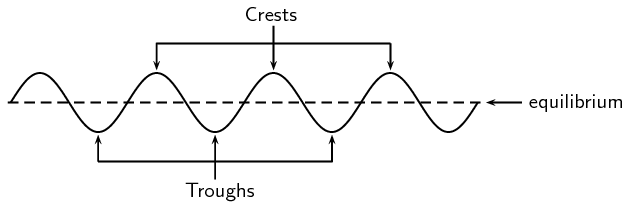
Waves have moving crests (or peaks) and troughs. A crest is the highest point the medium rises to and a trough is the lowest point the medium sinks to.

Crests and troughs on a transverse wave are shown in Figure 8.2.
406f92b4096ba695082700583c8f98cf.png

Figure 8.2: Crests and troughs in a transverse wave.

Crests and troughs

A crest is a point on the wave where the displacement of the medium is at a maximum. A point on the wave is a trough if the displacement of the medium at that point is at a minimum.