
Home Practice
For learners and parents For teachers and schools
Past papers Textbooks
Mathematics
Mathematics Grade 7 Mathematics Grade 8 Mathematics Grade 9 Mathematics Grade 10 Mathematics Grade 11 Mathematics Grade 12
Mathematical Literacy
Mathematical Literacy Grade 10
Physical Sciences
Physical Sciences Grade 10 Physical Sciences Grade 11 Physical Sciences Grade 12
Natural Sciences
Natural Sciences Grade 4 Natural Sciences Grade 5 Natural Sciences Grade 6 Natural Sciences Grade 7 Natural Sciences Grade 8 Natural Sciences Grade 9
Life Sciences
Life Sciences Grade 10
CAT
CAT Grade 10 CAT Grade 11 CAT Grade 12
IT
IT Grade 10 IT Grade 11 IT Grade 12
Full catalogue
Leaderboards
Learners Leaderboard Grades Leaderboard Schools Leaderboard
Campaigns
Headstart #MillionMaths
Learner opportunities Pricing Support
Help centre Contact us
Log in

We think you are located in South Africa. Is this correct?

1.6 Products

1.6 Products (EMAB)

Mathematical expressions are just like sentences and their parts have special names. You should be familiar with the words used to describe the parts of mathematical expressions. These words are given in the table below, using the following expression as an example:

\[3{x}^{2} + (7xy)^{3} - {125}\]

Name

Examples

term

\(3{x}^{2} \; ; \; (7xy)^{3} \; ; \; -125\)

expression

\(3{x}^{2} + (7xy)^{3} - {5}^{3}\)

coefficient

\(3 \; ; \; 7\)

exponent

\(2 \; ; \; 3\)

base

\(x \; ; \; 7xy \)

constant

\(-125\)

variable

\(x \; ; \; y\)

equation

\(3{x}^{2} + (7xy)^{3} - 125 = 0\)

Multiplying a monomial and a binomial (EMAC)

A monomial is an expression with one term, for example, \(3x\) or \({y}^{2}\). A binomial is an expression with two terms, for example, \(ax+b\) or \(cx+d\).

Worked example 7: Simplifying brackets

Simplify: \[2a\left(a - 1\right) - 3\left({a}^{2} - 1\right)\]

\begin{align*} 2a\left(a - 1\right) - 3\left({a}^{2}-1\right) & = 2a\left(a\right) + 2a\left(-1\right) + \left(-3\right)\left({a}^{2}\right) + \left(-3\right)\left(-1\right)\\ & = 2{a}^{2} - 2a - 3{a}^{2} + 3\\ & = -{a}^{2} - 2a + 3 \end{align*}
temp text

Multiplying two binomials (EMAD)

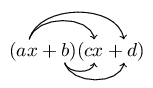
Here we multiply (or expand) two linear binomials:
f334bcd8bdb5bd2ed2b6202c5d4388ed.png

Worked example 8: Multiplying two binomials

Find the product: \(\left(3x-2\right)\left(5x+8\right)\)

\begin{align*} \left(3x - 2\right)\left(5x + 8\right) & = \left(3x\right)\left(5x\right) + \left(3x\right)\left(8\right) + \left(-2\right)\left(5x\right) + \left(-2\right)\left(8\right) \\ & = 15{x}^{2} + 24x - 10x - 16 \\ & = 15{x}^{2} + 14x - 16 \end{align*}
temp text

The product of two identical binomials is known as the square of the binomial and is written as:

\[{\left(ax + b\right)}^{2} = {a}^{2}{x}^{2} + 2abx + {b}^{2}\]

If the two terms are of the form \(ax + b\) and \(ax - b\) then their product is:

\[\left(ax + b\right)\left(ax - b\right) = {a}^{2}{x}^{2} - {b}^{2}\]

This product yields the difference of two squares.

Multiplying a binomial and a trinomial (EMAF)

A trinomial is an expression with three terms, for example, \(a{x}^{2} + bx + c\). Now we can learn how to multiply a binomial and a trinomial.

To find the product of a binomial and a trinomial, multiply out the brackets:

\[\left(A + B\right)\left(C + D + E\right) = A\left(C + D + E\right) + B\left(C + D + E\right)\]

This video shows some examples of multiplying a binomial and a trinomial.

Video: 2DFF

Worked example 9: Multiplying a binomial and a trinomial

Find the product: \(\left(x - 1\right)\left({x}^{2} - 2x + 1\right)\)

Expand the bracket

\[\left(x - 1\right)\left({x}^{2} - 2x + 1\right) = x\left({x}^{2} - 2x + 1\right) - 1\left({x}^{2} - 2x + 1\right) = {x}^{3} - 2{x}^{2} + x - {x}^{2} + 2x - 1\]

Simplify

\[{\left(x - 1\right)\left({x}^{2} - 2x + 1\right)} = {x}^{3} - 3{x}^{2} + 3x - 1\]

Textbook Exercise 1.4

Expand the following products:

\(2y(y+4)\)

\[2y(y+4) = 2y^{2} + 8y\]

\((y+5)(y+2)\)

\begin{align*} (y+5)(y+2) & = y^2 + 2y + 5y + 10\\ & = y^{2} + 7y + 10 \end{align*}

\((2 - t)(1 - 2t)\)

\begin{align*} (2 - t)(1 - 2t) & = 2 - 4t - t + 2t^{2}\\ & = 2t^{2} - 5t + 2 \end{align*}

\((x - 4)(x + 4)\)

\begin{align*} (x - 4)(x + 4) & = x^{2} + 4x - 4x - 16\\ & = x^{2} - 16 \end{align*}

\(-(4 - x)(x + 4)\)

\begin{align*} -(4 - x)(x + 4) &= -(4x + 16 - x^{2} - 4x) \\ & = -(16 - x^{2}) \\ & = -16 + x^{2} \\ & = x^{2} - 16 \end{align*}

\(-(a + b)(b - a)\)

\begin{align*} -(a + b)(b - a) &=(a + b)(a - b) \\ & = a^{2} + ba - ba - 16\\ & = a^{2} - b^{2} \end{align*}

\((2p + 9)(3p + 1)\)

\begin{align*} (2p + 9)(3p + 1) & = 6p^{2} + 2p + 27p + 9\\ & = 6p^{2} + 29p + 9 \end{align*}

\((3k - 2)(k + 6)\)

\begin{align*} (3k - 2)(k + 6) & = 3k^{2} + 18k - 2k - 12\\ & = 3k^{2} + 16k - 12 \end{align*}

\((s + 6)^{2}\)

\begin{align*} (s + 6)^{2} & = (s + 6)(s + 6) \\ & = s^{2} + 6s + 6s + 36\\ & = s^{2} + 12s + 36 \end{align*}

\(-(7 - x)(7 + x)\)

\begin{align*} -(7 - x)(7 + x) & = -(49 + 7x - 7x - x^{2}) \\ & = -(49 - x^{2})\\ & = x^{2} - 49 \end{align*}

\((3x - 1)(3x + 1)\)

\begin{align*} (3x - 1)(3x + 1) & = 9x^{2} + 3x - 3x - 1\\ & = 9x^{2} - 1 \end{align*}

\((7k + 2)(3 - 2k)\)

\begin{align*} (7k + 2)(3 - 2k) & = 21k - 14k^{2} + 6 - 4k\\ & = -14k^{2} + 17k + 6 \end{align*}

\((1 - 4x)^{2}\)

\begin{align*} (1 - 4x)^{2} & = (1 - 4x)(1 - 4x) \\ & = 1 - 4x - 4x + 16x^{2}\\ & = 16x^{2} - 8x + 1 \end{align*}

\((-3 - y)(5 - y)\)

\begin{align*} (-3 - y)(5 - y) & = -15 + 3y - 5y + y^{2}\\ & = y^{2} - 2y - 15 \end{align*}

\((8 - x)(8 + x)\)

\begin{align*} (8 - x)(8 + x) & = 64 + 8x - 8x - x^{2}\\ & = -x^{2} + 64 \end{align*}

\((9 + x)^{2}\)

\begin{align*} (9 + x)^{2} & = (9 + x)(9 + x)\\ & 81 + 9x + 9x + x^{2}\\ & = x^{2} + 18x + 81 \end{align*}

\((-7y + 11)(-12y + 3)\)

\begin{align*} (-7y + 11)(-12y + 3) & = 84y^{7} - 21y - 132y + 33\\ & = 84y^{2} - 153y + 33 \end{align*}

\((g - 5)^2\)

\begin{align*} (g - 5)^2 & = (g - 5)(g - 5) \\ & = g^2 - 5g - 5g + 25 \\ & = g^2 - 10g + 25 \end{align*}

\((d + 9)^2\)

\begin{align*} (d + 9)^2 & = (d + 9)(d + 9) \\ & = d^2 + 9d + 9d + 81\\ & = d^2 + 18d + 81 \end{align*}

\((6d + 7)(6d - 7)\)

\begin{align*} (6d + 7)(6d - 7) & = 36d^{2} - 42d + 42d - 49\\ &= 36d^{2} - 49 \end{align*}

\((5z + 1)(5z - 1)\)

\begin{align*} (5z + 1)(5z - 1) &= 25z^2 - 5z + 5z -1 \\ & = 25z^{2} - 1 \end{align*}

\((1 - 3h)(1 + 3h)\)

\begin{align*} (1 - 3h)(1 + 3h) &= 1 + 3h - 3h -9h^{2}\\ &= 1 - 9h^{2} \end{align*}

\((2p + 3)(2p + 2)\)

\begin{align*} (2p + 3)(2p + 2) &= 4p^2 + 4p + 6p + 6 \\ &= 4p^2 + 10p + 6 \end{align*}

\((8a + 4)(a + 7)\)

\begin{align*} (8a + 4)(a + 7) &= 8a^2 + 56a + 4a + 28 \\ &= 8a^{2} + 60a + 28 \end{align*}

\((5r + 4)(2r + 4)\)

\begin{align*} (5r + 4)(2r + 4) &= 10r^{2} + 20r + 8r + 16 \\ &= 10r^{2} + 28r + 16 \end{align*}

\((w + 1)(w - 1)\)

\begin{align*} (w + 1)(w - 1) &= w^2 + w - w - 1\\ &= {w}^2 - 1 \end{align*}

Expand the following products:

\((g + 11)(g - 11)\)

\begin{align*} (g + 11)(g - 11) & = g^2 + 11g - 11g - 121\\ & = g^2 - \text{121} \end{align*}

\((4b - 2)(2b - 4)\)

\begin{align*} (4b - 2)(2b - 4) & = 8b^{2} - 16b - 4b + 8 \\ &= 8b^{2} - 20b + 8 \end{align*}

\((4b - 3)(2b - 1)\)

\begin{align*} (4b - 3)(2b - 1) &= 8b^{2} - 4b - 6b + 3 \\ &= 8b^{2} - 10b + 3 \end{align*}

\((6x - 4)(3x + 6)\)

\begin{align*} (6x - 4)(3x + 6) &= 18x^{2} + 36x - 12x -24 \\ &= 18x^{2} + 24x - 24 \end{align*}

\((3w - 2)(2w + 7)\)

\begin{align*} (3w - 2)(2w + 7) &= 6w^{2} + 21w - 4 w - 14 \\ &= 6w^{2} + 17w - 14 \end{align*}

\((2t - 3)^2\)

\begin{align*} (2t - 3)^2 & = (2t - 3)(2t - 3) \\ & = 4t^{2} - 6t - 6t + 9 \\ &= 4t^{2} - 12t + 9 \end{align*}

\((5p - 8)^2\)

\begin{align*} (5p - 8)^2 & = (5p - 8)(5p - 8) \\ & = 25p^{2} - 40p - 40p + 64 \\ &= 25p^{2} - 80p + 64 \end{align*}

\((4y + 5)^2\)

\begin{align*} (4y + 5)^2 & = (4y + 5)(4y + 5) \\ & = 16 y^{2} + 20 y + 20 y + 25 \\ &= 16 y^{2} + 40y + 25 \end{align*}

\((2y^{6} + 3y^{5})(-5y - 12)\)

\begin{align*} (2y^{6} + 3y^{5})(-5y - 12) & = -10y^{7} - 24y^{6} - 15y^{6} - 36y^{5}\\ & = -10y^{7} - 39y^{6} - 36y^{5} \end{align*}

\(9(8y^{2} - 2y + 3)\)

\begin{align*} 9(8y^{2} - 2y + 3) & = 72y^{2} - 18y + 27 \end{align*}

\((-2y^{2} - 4y + 11)(5y - 12)\)

\begin{align*} (-2y^{2} - 4y + 11)(5y - 12) & = -10y^{3} - 20y^{2} + 55y + 24y^{2} + 48y - 132\\ & = -10y^{3} + 4y^{2} + 103y - 132 \end{align*}

\((7y^{2} - 6y - 8)(-2y + 2)\)

\begin{align*} (7y^{2} - 6y - 8)(-2y + 2) & = -14y^{3} + 12y^{2} + 16y + 14y^{2} - 12y - 16\\ & = -14y^{3} + 26y^{2} + 4y - 16 \end{align*}

\((10y + 3)(-2y^{2} - 11y + 2)\)

\begin{align*} (10y + 3)(-2y^{2} - 11y + 2) & = -20y^{3} - 110y^{2} + 20y - 6y^{2} - 33y + 6\\ & = -20y^{3} - 116y^{2} - 13y + 6 \end{align*}

\((-12y - 3)(2y^{2} - 11y + 3)\)

\begin{align*} (-12y - 3)(2y^{2} - 11y + 3) & = -24y^{3} + 132y^{2} - 36y - 6y^{2} + 33y - 9\\ & = -24y^{3} + 126y^{2} - 3y - 9 \end{align*}

\((-10)(2y^{2} + 8y + 3)\)

\begin{align*} (-10)(2y^{2} + 8y + 3) & = -20y^{2} - 80y - 30 \end{align*}

\((7y + 3)(7y^{2} + 3y + 10)\)

\begin{align*} (7y + 3)(7y^{2} + 3y + 10) & = 49y^{3} + 21y^{2} + 70y + 21y^{2} + 9y + 30\\ & = 49y^{3} + 42y^{2} + 79y + 30 \end{align*}
\((a+ 2b)(a^2 + b^2 + 2ab)\)
\begin{align*} (a+ 2b)(a^2 + b^2 + 2ab) &= a^3 + ab^2 + 2a^2b + 2a^2b + 2b^3 + 4ab^2 \\ &= a^3 + 4a^2b + 5ab^2 + 2b^3 \end{align*}
\((x+y)(x^2 - xy + y^2)\)
\begin{align*} (x+y)(x^2 - xy + y^2) &= x^3 - x^2y + xy^2 + x^2y - xy^2 + y^3 \\ &= x^3 + y^3 \end{align*}

\(3m(9m^2 + 2) + 5m^2(5m + 6)\)

\begin{align*} 3m(9m^2 + 2) + 5m^2(5m + 6) &= 27m^3 + 6m + 25m^3 + 30m^2\\ &= 52m^3 + 6m + 30m^2 \end{align*}

\(4x^2(10x^3 + 4) + 4x^3(2x^2 + 6)\)

\begin{align*} 4x^2(10x^3 + 4) + 4x^3(2x^2 + 6) &= 40x^5 + 16x^2 + 8x^5 + 24x^3\\ &= 48x^5 + 16x^2 + 24x^3 \end{align*}

\(\text{3}{k}^3({k}^2 + \text{3}) + \text{2}{k}^2(\text{6}{k}^3 + \text{7})\)

\begin{align*} \text{3}{k}^3({k}^2 + \text{3}) + \text{2}{k}^2(\text{6}{k}^3 + \text{7}) & = \text{3}{k}^5 + \text{9}{k}^3 + \text{12}{k}^5 + \text{14}{k}^2\\ &= \text{15}{k}^5 + \text{9}{k}^3 + \text{14}{k}^2 \end{align*}

\((3x + 2)(3x - 2)(9x^2 - 4)\)

\begin{align*} (3x + 2)(3x - 2)(9x^2 - 4) &= (9x^2- 4 )(9x^2 - 4) \\ & = 81x^4 -36x - 36x + 16 \\ & = 81x^4 -72x + 16 \end{align*}

\((-6y^{4} + 11y^{2} + 3y)(y + 4)(y - 4)\)

\begin{align*} (-6y^{4} + 11y^{2} + 3y)(y + 4)(y - 4) & = (-6y^{4} + 11y^{2} + 3y)(y^{2} - 16)\\ & = -6y^{6} + 96y^{4} + 11y^{4} - 176y^{2} + 3y^{3} - 48y\\ & = -6y^{6} + 107y^{4} + 3y^{3} - 176y^{2} - 48y \end{align*}

\((x + 2)(x - 3)(x^2 + 2x - 3)\)

\begin{align*} (x + 2)(x - 3)(x^2 + 2x - 3) &= (x^2 -x -6)(x^2 + 2x - 3) \\ & = x^4 + 2x^3 - 3x^2 - x^3 - 2x^2 + 3x - 6x^2 - 12x + 18 \\ & = x^4 + x^3 - 11x^2 - 9x + 18 \end{align*}
\((a + 2)^2 - (2a - 4)^2\)
\begin{align*} (a + 2)^2 - (2a - 4)^2 &= a^2 + 4a + 4 - (4a^2 - 16a + 16) \\ &= a^2 + 4a + 4 - 4a^2 + 16a - 16 \\ &= -3a^2 + 20a - 12 \end{align*}

Expand the following products:

\((2x + 3)^2 - (x-2)^2\)
\begin{align*} (2x + 3)^2 - (x-2)^2 &= 4x^2 + 12x + 9 - (x^2 - 4x + 4) \\ &= 4x^2 + 12x + 9 - x^2 + 4x - 4 \\ &= 3x^2 + 16x + 5 \end{align*}
\((2a^2 - a - 1 )(a^2 + 3a + 2)\)
\begin{align*} (2a^2 - a - 1 )(a^2 + 3a + 2) &= 2a^4 + 6a^3 + 4a^2 - a^3 - 3a^2 - 2a - a^2 - 3a - 2 \\ &= 2a^4 + 5a^3 - 5a - 2 \end{align*}
\((y^2 + 4y - 1)(1 - 4y - y^2)\)
\begin{align*} (y^2 + 4y - 1)(1 - 4y - y^2) &= y^2 - 4y^3 - y^4 + 4y - 16y^2 - 4y^3 - 1 + 4y + y^2 \\ &= -y^4 - 8y^3 - 14y^2 + 8y - 1 \end{align*}
\(2(x- 2y)(x^2 + xy + y^2)\)
\begin{align*} 2(x- 2y)(x^2 + xy + y^2) &= 2(x^3 + x^2y + xy^2 - 2x^2y - 2xy^2 - y^3) \\ &= 2(x^3 - x^2y - xy^2 - y^3) \\ &=2x^3 - 2x^2y - 2xy^2 - 2y^3 \end{align*}
\(3(a-3b)(a^2 + 3ab - b^2)\)
\begin{align*} 3(a-3b)(a^2 + 3ab - b^2) &= 3(a^3 + 3a^2b - ab^2 - 3a^2b - 9ab^2 + 3b^3) \\ &=3(a^3 - 10ab^{2} + 3b^3) \\ &= 3a^3- 30ab^{2} + 9b^3 \end{align*}
\((2a- b)(2a + b)(2a^2 - 3ab + b^2)\)
\begin{align*} (2a- b)(2a + b)(2a^2 - 3ab + b^2) &= (4a^2 - b^2)(2a^2 - 3ab + b^2) \\ &= 8a^4 - 12a^3b + 4a^2b^2 - 2a^2b^2 + 3ab^3 - b^4 \\ &= 8a^4 - 12a^3b + 2a^2b^2 + 3ab^3 - b^4 \end{align*}
\(2(3x + y)(3x - y) - (3x -y)^2\)
\begin{align*} 2(3x + y)(3x - y) - (3x -y)^2 &= 2(9x^2 - y^2) - 9x^2 + 6xy - y^2 \\ &= 18x^2 - 2y^2 - 9x^2 + 6xy - y^2 \\ &= 9x^2 + 6xy - 3y^2 \end{align*}
\((x+y)(x-3y) + (2x - y)^2\)
\begin{align*} (x+y)(x-3y) + (2x - y)^2 &= x^2 - 3xy +xy - 3y^2 + 4x^2 - 4xy + y^2 \\ &=5x^2 - 6xy - 2y^2 \end{align*}
\(\left(\dfrac{x}{3} - \dfrac{3}{x}\right)\left(\dfrac{x}{4} + \dfrac{4}{x}\right)\)
\begin{align*} \left(\frac{x}{3} - \frac{3}{x}\right)\left(\frac{x}{4} + \frac{4}{x}\right) &= \frac{x^2}{12} + \frac{4}{3} - \frac{3}{4} + \frac{12}{x^2} \\ & = \frac{x^2}{12} + \frac{16}{12} - \frac{9}{12} + \frac{12}{x^2} \\ &= \frac{x^2}{12} + \frac{7}{12} + \frac{3}{x^2} \end{align*}
\(\left(x - \dfrac{2}{x}\right)\left(\dfrac{x}{3} + \dfrac{4}{x}\right)\)
\begin{align*} \left(x - \frac{2}{x}\right)\left(\frac{x}{3} + \frac{4}{x}\right) &= \frac{x^2}{3} + 4 - \frac{2}{3} - \frac{8}{x^2} \\ & = \frac{x^2}{3} + \frac{12}{3} - \frac{2}{3} - \frac{8}{x^2} \\ &= \frac{x^2}{3} + \frac{10}{3} - \frac{8}{x^2} \end{align*}
\(\dfrac{1}{2}(10x -12y) + \frac{1}{3}(15x - 18y)\)
\begin{align*} \frac{1}{2}(10x - 12y) + \frac{1}{3}(15x - 18y) &= 5x - 6y + 5x - 6y \\ &= 10x - 12y \end{align*}
\(\dfrac{1}{2}a (4a + 6b) + \dfrac{1}{4}(8a + 12b)\)
\[\frac{1}{2}a (4a + 6b) + \frac{1}{4}(8a + 12b) = 2a^2 + 3ab + 2a + 3b\]

What is the value of \(b\), in \((x+b)(x-1)=x^2 + 3x - 4\)

\[(x + b)(x - 1) = x^{2} - x + bx - b\]

From the constant term we see that \(b = 4\). We can check the \(x\) term: \(-x + 4x = 3x\).

What is the value of \(g\), in \((x-2)(x+g)=x^2 - 6x + 8\)

\[(x - 2)(x + g) = x^{2} + gx - 2x - 2g\]

From the constant term we see that \(-2g = 8\), therefore \(g = -4\). We can check the \(x\) term: \(-4x - 2x = -6x\).

In \((x-4)(x+k) = x^2 + bx + c\):

For which of these values of \(k\) will \(b\) be positive?

\({-3 ; -1 ; 0 ; 3; 5}\)
\[(x - 4)(x + k) = x^{2} + kx - 4x - 4k\]

The \(x\) term is \(kx - 4x\) so for \(b\) to be positive \(k > 4\). Therefore \(k = 5\).

For which of these values of \(k\) will \(c\) be positive?

\({-3 ; -1 ; 0 ; 3; 5}\)
\[(x - 4)(x + k) = x^{2} + kx - 4x - 4k\]

The constant term is \(-4k\) so for \(c\) to be positive \(k < 0\). Therefore \(k = -3\) or \(k = -1\).

For what real values of \(k\) will \(c\) be positive?

From the previous question we see that \(k < 0\) will make \(c\) positive.

For what real values of \(k\) will \(b\) be positive?

From earlier we see that \(k > 4\) will make \(b\) positive.

Answer the following:

Expand \(\left(x + \dfrac{4}{x}\right)^2\).

\begin{align*} \left(x + \frac{4}{x}\right)^2 & = \left(x + \frac{4}{x}\right)\left(x + \frac{4}{x}\right) \\ & = x^2 + 8 + \frac{16}{x^2} \end{align*}

Given that \(\left(x+ \dfrac{4}{x}\right)^2 = 14\), determine the value of \(x^2 + \dfrac{16}{x^2}\) without solving for \(x\).

\[\left(x+ \frac{4}{x}\right)^2 = x^2 + 8 + \frac{16}{x^2}\]

Now we note that the above expression can also be written as \(x^2 + \dfrac{16}{x^2} + 8\). Since \(\left(x+ \dfrac{4}{x}\right)^2 = 14\) we get:

\begin{align*} 14 &= x^2 + 8 + \frac{16}{x^2} \\ 14 - 8 & = x^2 + \frac{16}{x^2} \\ 6 &= x^2 + \frac{16}{x^2} \end{align*}

Answer the following:

Expand: \(\left(a+ \dfrac{1}{a}\right)^2\)

\[\left(a+ \frac{1}{a}\right)^2 = a^2 + 2 + \frac{1}{a^2}\]

Given that \(\left(a+ \dfrac{1}{a}\right) = 3\), determine the value of \(\left(a+ \dfrac{1}{a}\right)^2\) without solving for \(a\).

\begin{align*} \left(a+ \frac{1}{a}\right)^2 &= 3^2 \\ &=9 \end{align*}

Given that \(\left(a - \dfrac{1}{a}\right) = 3\), determine the value of \(\left(a+ \dfrac{1}{a}\right)^2\) without solving for \(a\).

We note that:

\[\left(a + \frac{1}{a}\right)^2 = a^2 + 2 + \frac{1}{a^2}\] \[\left(a - \frac{1}{a}\right)^2 = a^2 - 2 + \frac{1}{a^2}\]

Next we note that if we add 4 to \(\left(a - \dfrac{1}{a}\right)^2\) we get \(\left(a + \dfrac{1}{a}\right)^2\). Therefore:

\begin{align*} \left(a + \frac{1}{a}\right)^2 &= a^2 - 2 + \frac{1}{a^2} + 4 \\ & = 3^{2} + 4 \\ &= 9 + 4 \\ &= 13 \end{align*}

Answer the following:

Expand: \(\left(3y+ \dfrac{1}{2y}\right)^2\)

\[\left(3y+ \frac{1}{2y}\right)^2 = 9y^2 + 3 + \frac{1}{4y^2}\]

Given that \(3y+ \dfrac{1}{2y} =4\), determine the value of \(\left(3y+ \dfrac{1}{2y}\right)^2\) without solving for \(y\).

\begin{align*} \left(3y+ \frac{1}{2y}\right)^2 &= 4^2 \\ &=16 \end{align*}

Answer the following:

Expand: \(\left(a + \dfrac{1}{3a}\right)^2\)

\[\left(a + \frac{1}{3a}\right)^2 = a^2 + \frac{2}{3} + \frac{1}{9a^2}\]

Expand: \(\left(a + \dfrac{1}{3a}\right)\left(a^2 - \dfrac{1}{3} + \dfrac{1}{9a^2}\right)\)

\begin{align*} \left(a + \frac{1}{3a}\right)\left(a^2 - \frac{1}{3} + \frac{1}{9a^2}\right) &= a^3 - \frac{1}{3}a + \frac{1}{9a} + \frac{1}{3}a - \frac{1}{9a} + \frac{1}{27a^3} \\ &=a^3 + \frac{1}{27a^3} \end{align*}

Given that \(a + \dfrac{1}{3a} = 2\), determine the value of \(a^3 + \dfrac{1}{27a^3}\) without solving for \(a\).

\begin{align*} a^3 + \frac{1}{27a^3} &= \left(a + \frac{1}{3a}\right)\left(a^2 - \frac{1}{3} + \frac{1}{9a^2}\right) \\ &= 2\left(a^2 - \frac{1}{3} + \frac{1}{9a^2}\right) \\ \\ a^2 - \frac{1}{3} + \frac{1}{9a^2} &= \left(a + \frac{1}{3a}\right)^2 - 1 \\ &= 4 - 1 \\ & = 3 \\ \\ a^3 + \frac{1}{27a^3} &= 2(3) \\ &= 6 \end{align*}