Home Practice
For learners and parents For teachers and schools
Past papers Textbooks
Mathematics
Mathematics Grade 7 Mathematics Grade 8 Mathematics Grade 9 Mathematics Grade 10 Mathematics Grade 11 Mathematics Grade 12
Mathematical Literacy
Mathematical Literacy Grade 10
Physical Sciences
Physical Sciences Grade 10 Physical Sciences Grade 11 Physical Sciences Grade 12
Natural Sciences
Natural Sciences Grade 4 Natural Sciences Grade 5 Natural Sciences Grade 6 Natural Sciences Grade 7 Natural Sciences Grade 8 Natural Sciences Grade 9
Life Sciences
Life Sciences Grade 10
CAT
CAT Grade 10 CAT Grade 11 CAT Grade 12
IT
IT Grade 10 IT Grade 11 IT Grade 12
Full catalogue
Leaderboards
Learners Leaderboard Grades Leaderboard Schools Leaderboard
Campaigns
Headstart #MillionMaths
Learner opportunities Pricing Support
Help centre Contact us
Log in

We think you are located in South Africa. Is this correct?

8.3 Summary

8.3 Summary (EMBJC)

  • Arc An arc is a portion of the circumference of a circle.
  • Chord - a straight line joining the ends of an arc.
  • Circumference - perimeter or boundary line of a circle.
  • Radius (\(r\)) - any straight line from the centre of the circle to a point on the circumference.
  • Diameter - a special chord that passes through the centre of the circle. A diameter is the length of a straight line segment from one point on the circumference to another point on the circumference, that passes through the centre of the circle.
  • Segment A segment is a part of the circle that is cut off by a chord. A chord divides a circle into two segments.
  • Tangent - a straight line that makes contact with a circle at only one point on the circumference.
  • A tangent line is perpendicular to the radius, drawn at the point of contact with the circle.
temp text
3f0288768e5a88e93e1abbd428eb05ae.png
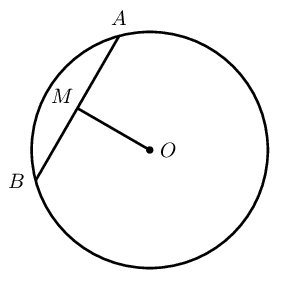
  • If \(O\) is the centre and \(OM \perp AB\), then \(AM = MB\).
  • If \(O\) is the centre and \(AM = MB\), then \(A\hat{M}O = B\hat{M}O = \text{90}\text{°}\).
  • If \(AM = MB\) and \(OM \perp AB\), then \(\Rightarrow MO\) passes through centre \(O\).
3dd0e185e58d62e2c26a4e76cedf896a.png

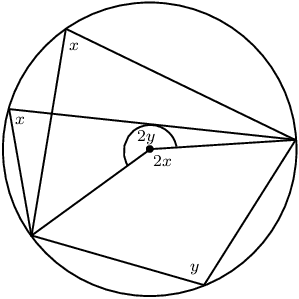
If an arc subtends an angle at the centre of a circle and at the circumference, then the angle at the centre is twice the size of the angle at the circumference.

f2885b0f02afdff4dba88ccf31b3e409.png

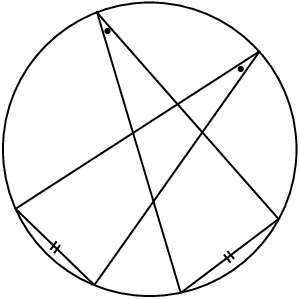
Angles at the circumference subtended by the same arc (or arcs of equal length) are equal.

d48fda8aae2300a3036eb8200ff3fbee.png

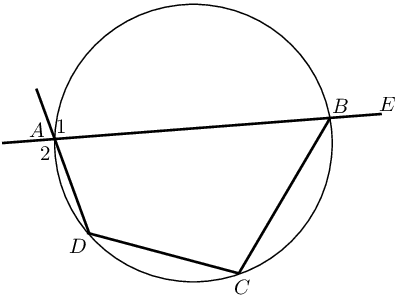
The four sides of a cyclic quadrilateral \(ABCD\) are chords of the circle with centre \(O\).

  • \(\hat{A} + \hat{C} = \text{180}\text{°}\) (opp. \(\angle\)s supp.)
  • \(\hat{B} + \hat{D} = \text{180}\text{°}\) (opp. \(\angle\)s supp.)
  • \(E\hat{B}C = \hat{D}\) (ext. \(\angle\) cyclic quad.)
  • \(\hat{A}_1 = \hat{A}_2 = \hat{C}\) (vert. opp. \(\angle\), ext. \(\angle\) cyclic quad.)
13a061174c3f30dc094f304ca75c2428.png

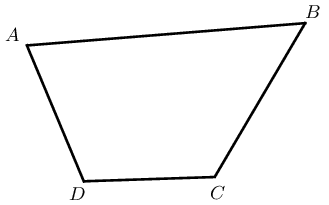
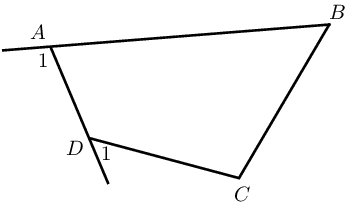
Proving a quadrilateral is cyclic: If \(\hat{A} + \hat{C} = \text{180}\text{°}\) or \(\hat{B} + \hat{D} = \text{180}\text{°}\), then \(ABCD\) is a cyclic quadrilateral.

58d45ad32242ce97af16542f89fc1322.png

If \(\hat{A}_1 = \hat{C}\) or \(\hat{D}_1 = \hat{B}\), then \(ABCD\) is a cyclic quadrilateral.

b6c4f7bc1dc2b6b0b44e63f9ed3382b7.png

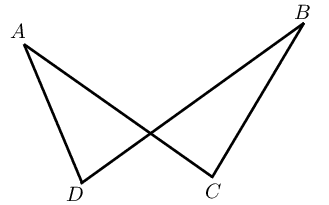
If \(\hat{A} = \hat{B}\) or \(\hat{C} = \hat{D}\), then \(ABCD\) is a cyclic quadrilateral.

59f361d74b3750f1bb8c709a83d0fd83.png

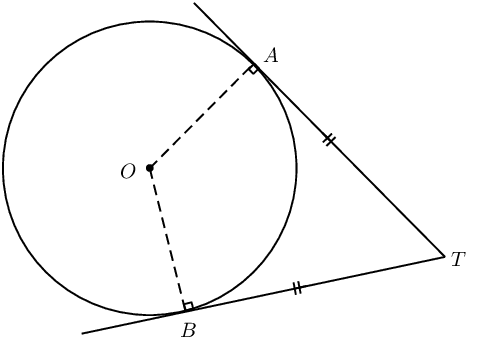
If \(AT\) and \(BT\) are tangents to circle \(O\), then

  • \(OA \perp AT\) (tangent \(\perp\) radius)
  • \(OB \perp BT\) (tangent \(\perp\) radius)
  • \(TA = TB\) (tangents from same point equal)
333ec9f4b2b83bf2441e9e8ea06e816f.png
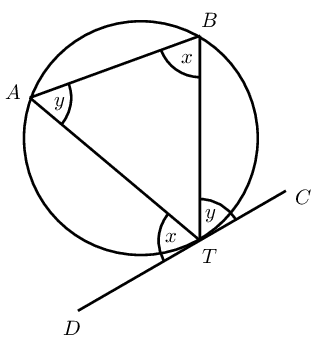
  • If \(DC\) is a tangent, then \(D\hat{T}A = T\hat{B}A\) and \(C\hat{T}B = T\hat{A}B\)
  • If \(D\hat{T}A = T\hat{B}A\) or \(C\hat{T}B = T\hat{A}B\), then \(DC\) is a tangent touching at \(T\)