Home Practice
For learners and parents For teachers and schools
Past papers Textbooks
Mathematics
Mathematics Grade 7 Mathematics Grade 8 Mathematics Grade 9 Mathematics Grade 10 Mathematics Grade 11 Mathematics Grade 12
Mathematical Literacy
Mathematical Literacy Grade 10
Physical Sciences
Physical Sciences Grade 10 Physical Sciences Grade 11 Physical Sciences Grade 12
Natural Sciences
Natural Sciences Grade 4 Natural Sciences Grade 5 Natural Sciences Grade 6 Natural Sciences Grade 7 Natural Sciences Grade 8 Natural Sciences Grade 9
Life Sciences
Life Sciences Grade 10
CAT
CAT Grade 10 CAT Grade 11 CAT Grade 12
IT
IT Grade 10 IT Grade 11 IT Grade 12
Full catalogue
Leaderboards
Learners Leaderboard Grades Leaderboard Schools Leaderboard
Campaigns
Headstart #MillionMaths
Learner opportunities Pricing Support
Help centre Contact us
Log in

We think you are located in South Africa. Is this correct?

End of chapter exercises

End of chapter exercises

Textbook Exercise 6.14

Write the following as a single trigonometric ratio: \(\dfrac{\cos (\text{90}\text{°} - A) \sin \text{20}\text{°}}{\sin (\text{180}\text{°} - A) \cos \text{70}\text{°}} + \cos (\text{180}\text{°} + A) \sin (\text{90}\text{°} + A)\)

\begin{align*} & \frac{\sin A \cdot \sin \text{20}\text{°}}{\sin A \cdot \sin( \text{90}\text{°} - \text{70}\text{°})} + (-\cos A)\cos (A) \\ &= \frac{\sin A \cdot \sin \text{20}\text{°}}{\sin A \cdot \sin \text{20}\text{°}} + (-\cos A)\cos A\\ &= 1 - \cos^2 A\\ &= \sin^2 A \end{align*}

Determine the value of the following expression without using a calculator: \(\sin\text{240}\text{°} \cos\text{210}\text{°} - \tan^2 \text{225}\text{°} \cos\text{300}\text{°} \cos\text{180}\text{°}\)

\begin{align*} & \sin(\text{180}\text{°} + \text{60}\text{°}) \cdot \cos(\text{180}\text{°} + \text{30}\text{°}) - \tan^2(\text{180}\text{°} + \text{45}\text{°}) \cdot \cos(\text{360}\text{°} - \text{60}\text{°}) \cdot (-1)\\ &= (-\sin \text{60}\text{°}) \cdot (-\cos \text{30}\text{°}) - (\tan^2 \text{45}\text{°}) \cdot (\cos \text{60}\text{°} ) \cdot (-1) \\ &= + \frac{\sqrt{3}}{2} \cdot \frac{\sqrt{3}}{2} - (1)^2 \cdot (\frac{1}{2}) \cdot (-1) \\ &= \frac{3}{4} + \frac{1}{2} \\ &= \frac{3 + 2}{4} \\ &= 1 \frac{1}{4} \end{align*}

Simplify: \(\dfrac{\sin (\text{180}\text{°} + \theta) \sin (\theta + \text{360}\text{°})}{\sin (-\theta) \tan (\theta - \text{360}\text{°})}\)

\begin{align*} &\frac{\sin(\text{180}\text{°} + \theta) \cdot \sin(\theta + \text{360}\text{°})}{\sin(-\theta) \cdot \tan(\theta - \text{360}\text{°})}\\ &= \frac{(- \sin \theta) \cdot \sin \theta}{(-\sin \theta) \cdot (- \tan(\text{360}\text{°} - \theta))}\\ &= \frac{\sin \theta}{\tan \theta} = \frac{\sin \theta}{1} \cdot \frac{\cos \theta}{\sin \theta}\\ &= \cos \theta \end{align*}

Without the use of a calculator, evaluate: \(\dfrac{3\sin \text{55}\text{°} \sin^2 \text{325}\text{°}}{\cos (-\text{145}\text{°})} - 3\cos \text{395}\text{°} \sin \text{125}\text{°}\)

\begin{align*} & \frac{3 \sin \text{55}\text{°} . \sin^2 (\text{360}\text{°} - (\text{35}\text{°}))}{\cos (\text{145}\text{°}} - 3\cos((\text{360}\text{°} + (\text{35}\text{°}) . \sin(\text{90}\text{°} + \text{35}\text{°})\\ &= \frac{3 \sin \text{55}\text{°} . (-\sin \text{35}\text{°})^2}{\cos (\text{90}\text{°} + \text{55}\text{°})} + 3\cos \text{35}\text{°} . \cos \text{35}\text{°}\\ &= \frac{-3 \sin \text{55}\text{°} . \sin^2 \text{35}\text{°}}{-\sin \text{55}\text{°}} + 3\cos^2 \text{35}\text{°}\\ &= 3(\sin^2 \text{35}\text{°} + \cos^2 \text{35}\text{°})\\ &= 3 \end{align*}

Prove the following identities:

\(\dfrac{1}{(\cos x - 1)(\cos x + 1)} = \dfrac{-1}{\tan^2x \cos^2x}\)
\begin{align*} \text{ RHS }&=\frac{-1}{\frac{\sin^2x}{\cos^2x}\cdot\frac{\cos^2x}{1}} \\ &=\frac{-1}{\sin^2x} \\ \text{ LHS } &=\frac{1}{\cos^2x-1} \\ &=\frac{1}{-(1-\cos^2x)} \\ &=-\frac{1}{\sin^2x} \\ &=\text{ RHS } \end{align*}
\((1 - \tan \alpha) \cos \alpha = \sin(90 + \alpha) + \cos(90 + \alpha)\)
\begin{align*} \text{LHS} &= (1 - \frac{\sin \alpha}{\cos \alpha}) . \cos \alpha \\ &= (\frac{\cos \alpha - \sin \alpha}{\cos \alpha} ) \cos \alpha \\ &= \cos \alpha - \sin \alpha \\ \text{RHS} &= \cos (-\alpha) + \sin (-\alpha) \\ &= \cos \alpha - \sin \alpha \\ &= \text{LHS} \end{align*}

Prove: \(\tan y + \dfrac{1}{\tan y} = \dfrac{1}{\cos^2y \tan y}\)

\begin{align*} \text{LHS} &= \frac{\sin y}{\cos y} + \frac{1}{\frac{1}{\sin y}{\cos y}}\\ &= \frac{\sin y}{\cos y} + \frac{\cos y}{\sin y}\\ &= \frac{\sin^2 y + \cos^2 y}{\cos y . \sin y}\\ &= \frac{1}{\cos y . \sin y}\\ \text{RHS} &= \frac{1}{\cos^2 y \frac{\sin y}{\cos y}}\\ &= \frac{\cos y}{\cos^2 y . \sin y}\\ &= \frac{1}{\cos y \sin y}\\ &= \text{LHS} \end{align*}

For which values of \(y \in [\text{0}\text{°};\text{360}\text{°}]\) is the identity above undefined?

\begin{align*} \tan y &= \text{0}\text{°}\\ y &= \text{0}\text{°}; \text{180}\text{°}; \text{360}\text{°}\\ \cos y &= \text{0}\text{°}\\ y &= \text{90}\text{°}; \text{270}\text{°} \end{align*}

Simplify: \(\dfrac{\sin(\text{180}\text{°} + \theta) \tan(\text{360}\text{°} - \theta)}{\sin(-\theta) \tan(\text{180}\text{°} + \theta)}\)

\begin{align*} & \frac{(-\sin \theta) . (- \tan \theta)}{(-\sin \theta) . \tan \theta} \\ & = -1 \end{align*}

Hence, solve the equation \(\dfrac{\sin(\text{180}\text{°} + \theta) \tan(\text{360}\text{°} - \theta)}{\sin(-\theta) \tan(\text{180}\text{°} + \theta)} = \tan \theta\) for \(\theta \in [\text{0}\text{°};\text{360}\text{°}]\).

\begin{align*} \tan \theta &= -1 \\ \therefore \theta &= \text{180}\text{°} - \text{45}\text{°} \text{ or } \theta = \text{360}\text{°} - \text{45}\text{°} \\ &= \text{135}\text{°} \text{ or } \text{315}\text{°} \end{align*}

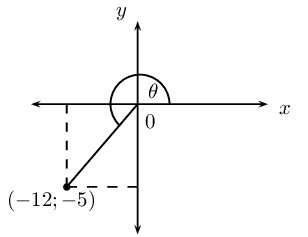
Given \(12 \tan \theta = 5\) and \(\theta > \text{90}\text{°}\).

Draw a sketch.

c81c7f13e9e11dce1a2b9b5c69bcf165.png

Determine without using a calculator \(\sin \theta\) and \(\cos (\text{180}\text{°} + \theta)\).

\begin{align*} OP &= \sqrt{(-12)^2 + (-5)^2} \\ &= \sqrt{144 + 25} \\ &= \sqrt{169}\\ &= 13\\ \sin \theta &= - \frac{5}{13}\\ \cos (\text{180}\text{°} + \theta) &= - \cos \theta \\ &= - (-\frac{12}{13}) \\ &= \frac{12}{13} \end{align*}

Use a calculator to find \(\theta\) (correct to two decimal places).

\begin{align*} \tan \theta &= \frac{5}{12} \\ \theta &= \text{180}\text{°} + \text{22,62}\text{°}\\ &= \text{202,62}\text{°} \end{align*}
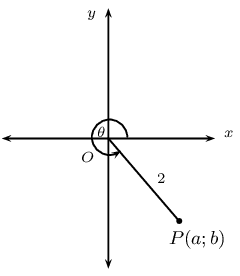
1b43c934975770805f31ae59f835b837.png

In the figure, \(P\) is a point on the Cartesian plane such that \(OP = 2\) units and \(\theta = \text{300}\text{°}\). Without the use of a calculator, determine:

the values of \(a\) and \(b\)

\begin{align*} \cos \text{300}\text{°} &= \cos \text{60}\text{°} \\ & = \frac{1}{2}\\ \therefore a &= 1 \\ b &= - \sqrt{4-1} \\ & = -\sqrt{3} \end{align*}

the value of \(\sin (\text{180}\text{°} - \theta)\)

\begin{align*} \sin (\text{180}\text{°} - \theta) &= \sin \theta \\ &= \sin \text{300}\text{°} \\ &= \sin (\text{360}\text{°} - \text{60}\text{°})\\ &= \sin (-\text{60}\text{°})\\ &= -\sin \text{60}\text{°}\\ &= - \frac{\sqrt{3}}{2} \end{align*}

Solve for \(x\) with \(x \in [-\text{180}\text{°};\text{180}\text{°}]\) (correct to one decimal place):

\(2 \sin \frac{x}{2} = \text{0,86}\)
\begin{align*} \sin \frac{1}{2}x &= \text{0,43} \\ \frac{1}{2}x &= \text{25,467}\text{°}\\ x &= \text{50,9}\text{°} \\ \text{Or } \quad \frac{1}{2}x &=\text{180}\text{°} - \text{25,467}\text{°}\\ x &= \text{309,1}\text{°} \end{align*}
\(\tan (x + \text{10}\text{°}) = \cos \text{202,6}\text{°}\)
\begin{align*} \tan (x + \text{10}\text{°}) &= -\text{0,92}\\ x + \text{10}\text{°} &= \text{180}\text{°} -\text{42,7}\text{°}\\ &= \text{137,3}\text{°}\\ x &= \text{127,3}\text{°}\\ \text{Or} \quad x + \text{10}\text{°} &= \text{360}\text{°} - \text{42,7}\text{°}\\ &= \text{317,3}\text{°}\\ \therefore x &= \text{307,3}\text{°} \end{align*}
\(\cos^2x - 4 \sin^2x = 0\)
\begin{align*} \cos x - 2\sin x &= 0\\ \cos x &= 2\sin x\\ \frac{\sin x}{\cos x} &= \frac{1}{2}\\ \tan x &= \frac{1}{2}\\ x &= \text{26,6}\text{°}\\ \text{or } x &= -\text{180}\text{°} + \text{26,6}\text{°} \\ &= \text{206,6}\text{°}\\ \text{Or } \quad \cos x + 2\sin x &= 0\\ \cos x &= -2 \sin x\\ \frac{\sin x}{\cos x} &= -\frac{1}{2}\\ \tan x &= -\frac{1}{2}\\ x &= \text{180}\text{°} - \text{26,6}\text{°}\\ &= \text{153,4}\text{°}\\ \text{or } x &= \text{360}\text{°} - \text{26,6}\text{°} \\ &= \text{333,4}\text{°} \end{align*}

Find the general solution for the following equations:

\(\frac{1}{2} \sin (x - \text{25}\text{°}) = \text{0,25}\)
\begin{align*} \sin(x - \text{25}\text{°}) &= 0.5\\ x - \text{25}\text{°} &= \text{30}\text{°} \\ \text{ or } x - \text{25}\text{°} &= \text{180}\text{°} - \text{30}\text{°}\\ x &= \text{55}\text{°} + \text{360}\text{°}n, n \in \mathbb{Z} \\ \text{ or } x &= \text{175}\text{°} + \text{360}\text{°}n, n \in \mathbb{Z} \end{align*}
\(\sin^2x + 2 \cos x = -2\)
\begin{align*} \sin^2 x + 2\cos x + 2 &= 0\\ 1 - \cos^2 x + 2\cos x + 2 &= 0\\ - \cos^2 x + 2\cos x + 3 &= 0\\ \cos^2 x - 2\cos x - 3 &= 0\\ (\cos x - 3)(\cos x + 1) &= 0\\ \cos x &= 3 \\ & \text{no solution} \\ \text{OR} \cos x &= -1\\ x &= \text{180}\text{°} + \text{360}\text{°}n, n \in \mathbb{Z} \end{align*}

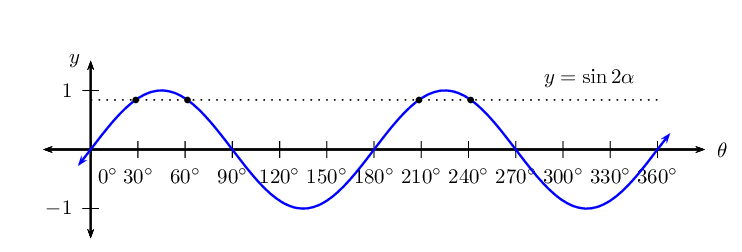
Given the equation: \(\sin 2 \alpha = \text{0,84}\)

Find the general solution of the equation.
\begin{align*} \sin 2\alpha &= \text{0,84}\\ 2\alpha &= \text{57,14}\text{°} + \text{360}\text{°}n, n \in \mathbb{Z}\\ \alpha &= \text{28,6}\text{°} + \text{180}\text{°}n\\ \text{Or } 2\alpha &= \text{180}\text{°} - \text{57,14}\text{°} + \text{360}\text{°}n, n \in \mathbb{Z}\\ 2\alpha &= \text{122,86}\text{°} + \text{360}\text{°}n\\ \alpha &= \text{61,43}\text{°} + \text{180}\text{°}n \end{align*}
Illustrate how this equation could be solved graphically for \(\alpha \in [\text{0}\text{°}; \text{360}\text{°}]\).
5065612b2bde79231725f566535f680e.png
Write down the solutions for \(\sin 2 \alpha = \text{0,84}\) for \(\alpha \in [\text{0}\text{°}; \text{360}\text{°}]\).
\(\text{28,6}\text{°}; \text{61,4}\text{°}; \text{208,6}\text{°}; \text{241,4}\text{°}\)
a92d4ff13a167361af24f8da55941296.png

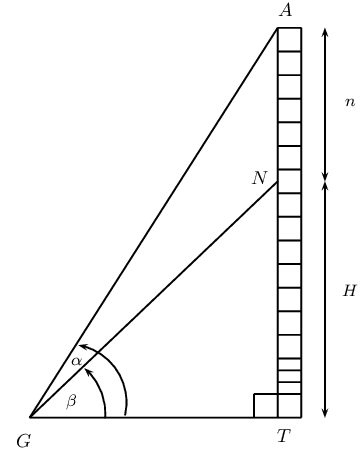
\(A\) is the highest point of a vertical tower \(AT\). At point \(N\) on the tower, \(n\) metres from the top of the tower, a bird has made its nest. The angle of inclination from \(G\) to point \(A\) is \(\alpha\) and the angle of inclination from \(G\) to point \(N\) is \(\beta\).

Express \(A\hat{G}N\) in terms of \(\alpha\) and \(\beta\).

\begin{align*} A\hat{G}N &= \alpha - \beta \end{align*}

Express \(\hat{A}\) in terms of \(\alpha\) and/or \(\beta\).

\begin{align*} \hat{A} &= \text{90}\text{°} - \alpha \end{align*}

Show that the height of the nest from the ground (\(H\)) can be determined by the formula \[H = \frac{n \cos \alpha \sin \beta}{\sin(\alpha - \beta)}\]

\begin{align*} \text{In } \triangle GNT, & \\ \frac{H}{GN} &= \sin \beta \\ \therefore H &= GN \sin \beta \\ \text{In } \triangle AGN, & \\ \frac{n}{\sin(\alpha - \beta)} &= \frac{GN}{\sin(\text{90}\text{°} - \alpha)}\\ \therefore GN &= \frac{n \sin(\text{90}\text{°} - \alpha)}{\sin(\alpha - \beta)} \\ & = \frac{n \cos \alpha}{\sin(\alpha - \beta)} \\ \text{Substitute for } GN, & \\ H &= \frac{n \cos \alpha \sin \beta}{\sin(\alpha-\beta)} \end{align*}

Calculate the height of the nest \(H\) if \(n = \text{10}\text{ m}\), \(\alpha = \text{68}\text{°}\) and \(\beta = \text{40}\text{°}\) (give your answer correct to the nearest metre).

\begin{align*} H &= \frac{n \cos \alpha \sin \beta}{\sin(\alpha-\beta)}\\ &= \frac{10 \cos \text{68}\text{°} \sin \text{40}\text{°}}{\sin \text{28}\text{°}}\\ &= \text{5,1}\text{ m} \end{align*}
730f1d48277a2226f28f673b68d9e691.png

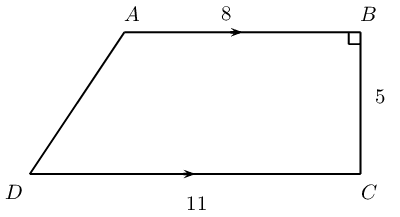
Mr. Collins wants to pave his trapezium-shaped backyard, \(ABCD\). \(AB \parallel DC\) and \(\hat{B} = \text{90}\text{°}\). \(DC = \text{11}\text{ m}\), \(AB = \text{8}\text{ m}\) and \(BC = \text{5}\text{ m}\).

Calculate the length of the diagonal \(AC\).
\begin{align*} AC^2 &= 8^2 + 5^2\\ &= 64 + 25 = 89\\ AC &= \text{9,43}\text{ m} \end{align*}
Calculate the length of the side \(AD\).
\begin{align*} \text{In } \triangle ABC, &\\ \tan B\hat{A}C &= \frac{5}{8}\\ \therefore B\hat{A}C &= \text{32}\text{°}\\ A\hat{C}D = B\hat{A}C &= \text{32}\text{°} (AB \parallel DC)\\ \text{In } \triangle ADC, &\\ AD^2 &= AC^2 + DC^2 - 2.AC.AD.\cos(A\hat{C}D)\\ &= (\text{9,4})^2 + (\text{11})^2 - 2 (\text{9,4})(\text{11}) \cos(\text{32}\text{°})\\ &= 89 + 121 - 176\\ &= 34\\ \therefore AD &= \text{6,2}\text{ m} \end{align*}
Calculate the area of the patio using geometry.
\begin{align*} \text{Area } &= \frac{1}{2} \times (8+11) \times 5 \\ &= \text{47,5}\text{ m$^{2}$} \end{align*}
Calculate the area of the patio using trigonometry.
\begin{align*} \text{Area } ABCD &= \text{area } \triangle ABC + \text{area } \triangle ADC \\ &= \frac{1}{2} (8) (5) + \frac{1}{2} (9.43) (11) \sin \text{32}\text{°}\\ &= 20 + \text{27,5}\\ &= \text{47,5}\text{ m$^{2}$} \end{align*}
cf0fdbc9722f10874ea8e37c0569d6f7.png

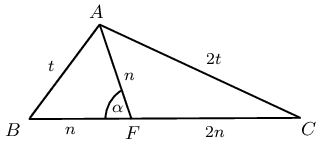
In \(\triangle ABC\), \(AC = 2A\), \(AF = BF\), \(A\hat{F}B = \alpha\) and \(FC = 2AF\). Prove that \(\cos \alpha = \frac{1}{4}\).

\begin{align*} \text{In } \triangle ABF & \\ t^2 &= n^2 + n^2 - 2n^2 \cos \alpha \\ t^2 &= 2n^2(1 - \cos \alpha) \\ 1 - \cos \alpha &= \frac{t^2}{2n^2}\\ \cos \alpha &= 1 - \frac{t^2}{2n^2} \\ \text{In } \triangle AFC & \\ (2t)^2 &= n^2 + (2n)^2 - 4n^2 \cos (A\hat{F}C)\\ 4t^2 &= n^2 + 4n^2 - 4n^2 \cos (\text{180}\text{°} - \alpha) \\ &= 5n^2 + 4n^2 \cos \alpha\\ t^2 &= \frac{5}{4} n^2 + n^2 \cos \alpha \\ \text{Substitute for } t^2 & \\ \cos \alpha &= 1 - \frac{\frac{5}{4}n^2 + n^2 \cos \alpha}{2n^2}\\ &= \frac{2n^2 - \frac{5}{4}n^2 - n^2 \cos \alpha}{2 n^2}\\ &= \frac{\frac{3}{4}n^2 - n^2 \cos \alpha}{2n^2}\\ &= \frac{3}{8} - \frac{\cos \alpha}{2}\\ \frac{3}{2} \cos \alpha &= \frac{3}{8}\\ \therefore \cos \alpha &= \frac{1}{4} \end{align*}