
7.1 Introduction and key concepts
|
Previous
End of chapter exercises
|
Next
7.2 Pulses: amplitude and length
|
Chapter 7: Transverse pulses
7.1 Introduction and key concepts (ESACF)
This chapter forms the basis of the discussion into mechanical waves in the following chapters. We begin by discussing pulses. Pulses are disturbances in a medium. If you tap water in a bucket with your finger, notice that a ripple moves away from the point where you touched the water. The ripple is a pulse moving away from where you touched the water.
What is a medium?(ESACG)
A medium is the substance or material through which a pulse moves. The medium carries the pulse from one place to another. The medium does not create the pulse and the medium is not the pulse. Therefore the medium does not travel with the pulse as the pulse moves through it.
In each medium, the particles that make up the medium are moved temporarily from their rest position. In order for a pulse to travel, the different parts of the medium must be able to interact with each other.
- Medium
-
A medium is the substance or material in which a pulse will move.
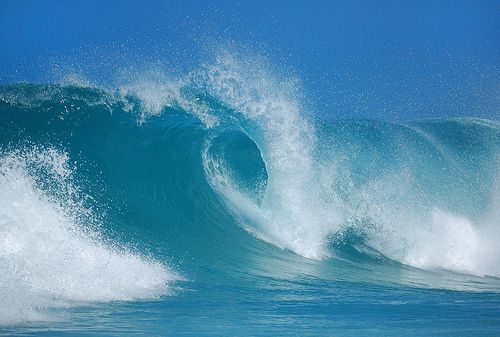
A disturbance in water
|
Previous
End of chapter exercises
|
Table of Contents |
Next
7.2 Pulses: amplitude and length
|