
10.5 Ultrasound
|
Previous
10.4 Intensity of sound [NOT IN CAPS]
|
Next
10.6 The physics of hearing [NOT IN CAPS]
|
10.5 Ultrasound (ESADF)
Ultrasound is sound with a frequency that is higher than \(\text{20}\) \(\text{kHz}\). Some animals, such as dogs, dolphins, and bats, have an upper limit that is greater than that of the human ear and can hear ultrasound.
|
Application |
Lowest Frequency (kHz) |
Highest Frequency (kHz) |
|
Cleaning (e.g. jewellery) |
20 |
40 |
|
Material testing for flaws |
50 |
500 |
|
Welding of plastics |
15 |
40 |
|
Tumour ablation |
250 |
2000 |
Table 10.5: Different uses of ultrasound and the frequencies applicable.
The most common use of ultrasound is to create images, and has industrial and medical applications. The use of ultrasound to create images is based on the reflection and transmission of a wave at a boundary (when the wave goes from one substance to another). When an ultrasound wave travels inside an object that is made up of different materials such as the human body, each time it encounters a boundary, e.g. between bone and muscle, or muscle and fat, part of the wave is reflected and part of it is transmitted. The reflected rays are detected and used to construct an image of the object.
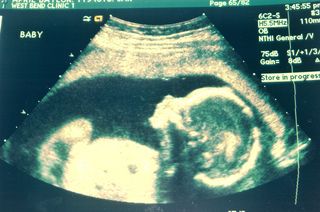
Ultrasound in medicine can visualise muscle and soft tissue, making them useful for scanning the organs, and is commonly used during pregnancy. Ultrasound is a safe, non-invasive method of looking inside the human body.
Ultrasound image of a unborn baby
Ultrasound generator/speaker systems are sold with claims that they frighten away rodents and insects, but there is no scientific evidence that the devices work; controlled tests have shown that rodents quickly learn that the speakers are harmless.
Ultrasound sources may be used to generate local heating in biological tissue, with applications in physical therapy and cancer treatment. Focused ultrasound sources may be used to break up kidney stones.
Ultrasonic cleaners, sometimes called supersonic cleaners, are used at frequencies from 20-40 kHz for jewellery, lenses and other optical parts, watches, dental instruments, surgical instruments and industrial parts. These cleaners consist of containers with a fluid in which the object to be cleaned is placed. Ultrasonic waves are then sent into the fluid. The main mechanism for cleaning action in an ultrasonic cleaner is actually the energy released from the collapse of millions of microscopic bubbles occurring in the liquid of the cleaner.
|
Previous
10.4 Intensity of sound [NOT IN CAPS]
|
Table of Contents |
Next
10.6 The physics of hearing [NOT IN CAPS]
|