Give one word or term for each of the following
descriptions.
The change in phase from a solid to a gas.
The change in phase from liquid to gas.
sublimation and evaporation
Water has a boiling point of 100℃
Define boiling point.
What change in phase takes place when a liquid reaches its
boiling point?
see definition
liquid to gas
Describe a solid in terms of the kinetic molecular theory.
Solution not yet available.
Refer to the table below which gives the melting and
boiling points of a number of elements and then answer the questions
that follow. (Data from http://www.chemicalelements.com)
Element
Melting point (℃)
Boiling point (℃)
copper
\(\text{1 083}\)
\(\text{2 567}\)
magnesium
\(\text{650}\)
\(\text{1 107}\)
oxygen
\(-\text{218,4}\)
\(-\text{183}\)
carbon
\(\text{3 500}\)
\(\text{4 827}\)
helium
\(-\text{272}\)
\(-\text{268,6}\)
sulphur
\(\text{112,8}\)
\(\text{444,6}\)
What state of matter (i.e. solid, liquid or gas) will each of
these elements be in at room temperature (25℃)?
Which of these elements has the strongest forces
between its atoms? Give a reason for your answer.
Which of these elements has the weakest forces between
its atoms? Give a reason for your answer.
solid, solid, gas, solid, gas, solid
carbon
helium
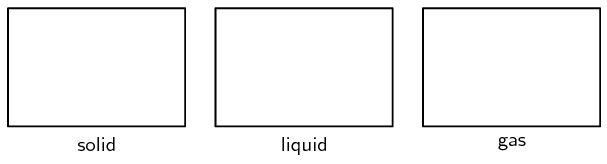
Complete the following submicroscopic diagrams to show what magnesium will
look like in the solid, liquid and gas phase.