24.2 The Cartesian plane
In the previous chapter, we learned that the position of any point on the Cartesian plane can be represented by
a set of coordinates called an ordered pair. An ordered pair consists of a \(T(4; 5)\).
Worked example 24.1: Finding
the coordinates of a given point
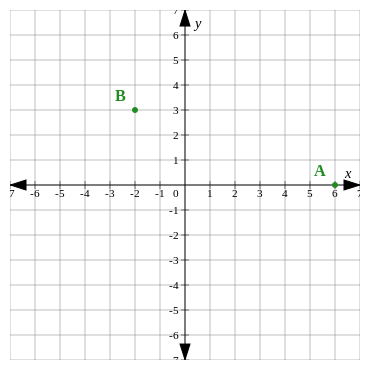
The diagram shows the Cartesian plane and two points. The points are labelled \(A\) and \(B\). What are the
coordinates of point \(B\)?
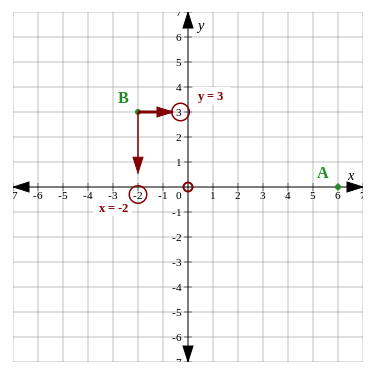
Read the coordinates from the axes.
We need to find the \(x\)-value and the \(y\)-value which tell us the position of point \(B\) from the
origin.
To find the \(x\)-value, we read how many units on the \(x\)-axis point \(B\) is left or right of the
origin (where the two axes cross; labelled 0). The \(x\)-coordinate is \(-2\).
To find the \(y\)-value, we read how many units on the \(y\)-axis point \(B\) is up or down from the
origin. The \(y\)-coordinate is \(3\).
Notice that the value of the \(x\)-coordinate shows that the point lies to the left or to the right of
the origin. The value of the \(y\)-coordinate shows that the point lies above or below the origin.
Remember the order of coordinate pairs: \( (x;y) \). The \(x\)-coordinate is always written first and the
\(y\)-coordinate is written second.
Write the final answer.
The coordinates of point \( B \) are \( (-2;3) \).
Exercise 24.1
-
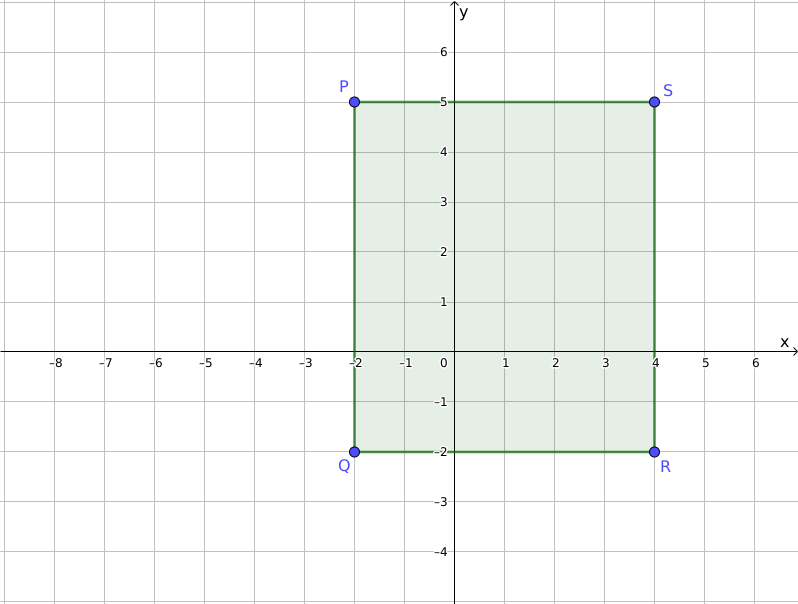
Plot the four points \(P(-2; 5)\), \(Q(-2; -2)\), \(R(4; -2)\) and \(S(4; 5)\) on the Cartesian
plane.
-
Name the quadrant in which each point lies.
-
What type of shape is \(PQRS\)?
-
\( P \) lies in quadrant II
\( Q \) lies in quadrant III
\( R \) lies in quadrant IV
\( S \) lies in quadrant I
- \(PQRS\) is a rectangle.
-
Plot the points \(A(-4; 5)\), \(B(-2; -3)\) and \(C(0; 2)\) on the Cartesian plane.
-
In which quadrant does point \(B\) lie?
-
What type of shape is \(ABC\)?
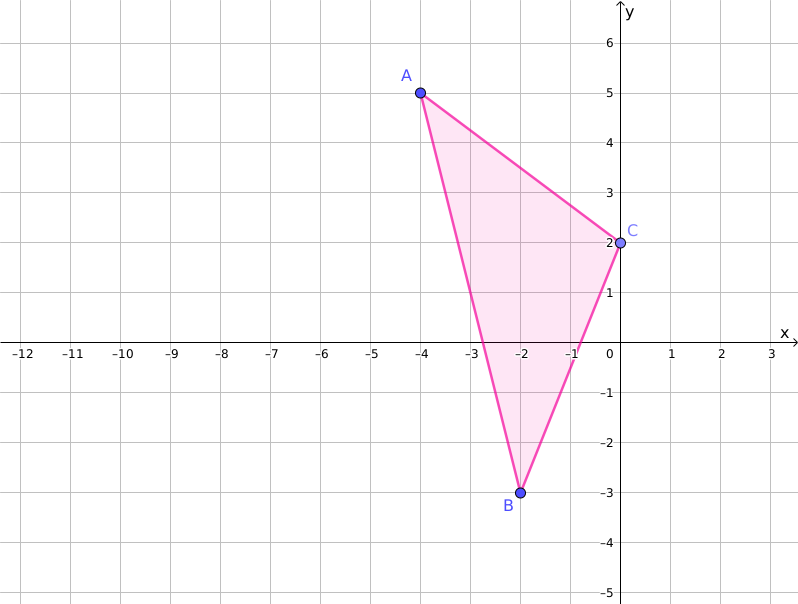
- Point \( B \) lies in quadrant III
- \(ABC\) is a scalene triangle.
-
Plot the points \(M(0; -4)\), \(N(6; -4)\), \(P(6; 2)\) and \(Q(0; 2)\) on the Cartesian plane.
-
What type of shape is \(MNPQ\)?
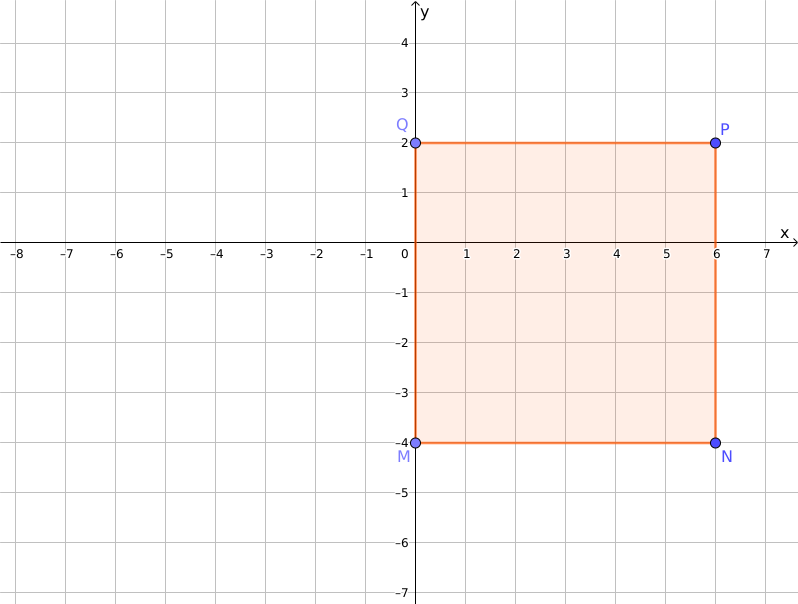
- \(MNPQ\) is a square
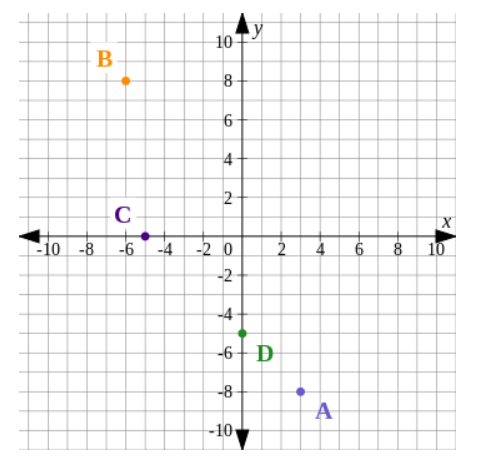
Use the diagram to answer the questions.
- For which point does \(y = -8\)?
- For which point(s) does \(x = -6\)?
- For which point does \(y = -5\)?
- For which point(s) does \(x = 0\)?
- For which point(s) does \(y = 0\)?
- Write down the coordinates of points \(A\), \(B\), \(C\) and \(D\).
- \(A\)
- \(B\)
- \(D\)
- \(D\)
- \(C\)
- \(A(3; -8)\), \(B(-6; 8)\), \(C(-5; 0)\), \(D(0; -5)\)