Give one word or term for each of the following descriptions.
A composition of two or more atoms that act as a unit.
Chemical formula that gives the relative number of atoms of
each element that are in a molecule.
Solution not yet available
Give a definition for each of the following terms:
molecule
ionic compound
covalent network structure
empirical formula
ball-and-stick model
Solution not yet available
Ammonia, an ingredient in household cleaners, is made up of one part nitrogen
(\(\text{N}\)) and three parts hydrogen (\(\text{H}\)). Answer the
following questions:
is ammonia a covalent, ionic or metallic substance?
write down the molecular formula for ammonia
draw a ball-and-stick diagram
draw a space-filling diagram
Solution not yet available
In each of the following, say whether the chemical substance is made up of
covalent, molecular structures, covalent network structures, ionic
network structures or metallic structures:
ammonia gas (\(\text{NH}_{3}\))
zinc metal (\(\text{Zn}\))
graphite (\(\text{C}\))
nitric acid (\(\text{HNO}_{3}\))
potassium bromide (\(\text{KBr}\))
Solution not yet available
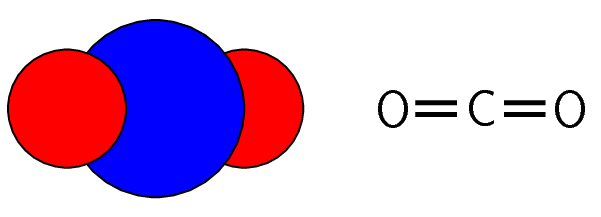
Refer to the diagram below and then answer the
questions that follow:
Identify the molecule.
Write the molecular formula for the molecule.
Is the molecule a covalent, ionic or metallic substance?
Explain.
Solution not yet available
Represent each of the following molecules using its chemical
formula, structural formula and the
ball-and-stick model.